
Edition 4 of IEC 61131-3 has been available online since May 2025. In the following post, I will briefly explain the most important differences between Edition 3 and Edition 4.
Continue reading “IEC 61131-3: Comparison of Edition 3 and Edition 4”Author: Stefan Henneken
I’m Stefan Henneken, a software developer based in Germany. This blog is just a collection of various articles I want to share, mostly related to Software Development.
IEC 61131-3: Vergleich Edition 3 und Edition 4
Seit Mai 2025 ist die Edition 4 der IEC 61131-3 online verfügbar. Im folgenden Post gehe ich kurz auf die wichtigsten Unterschiede zwischen der Edition 3 und der Edition 4 ein.
Continue reading “IEC 61131-3: Vergleich Edition 3 und Edition 4”Book release „Use of the SOLID principles with IEC 61131-3“
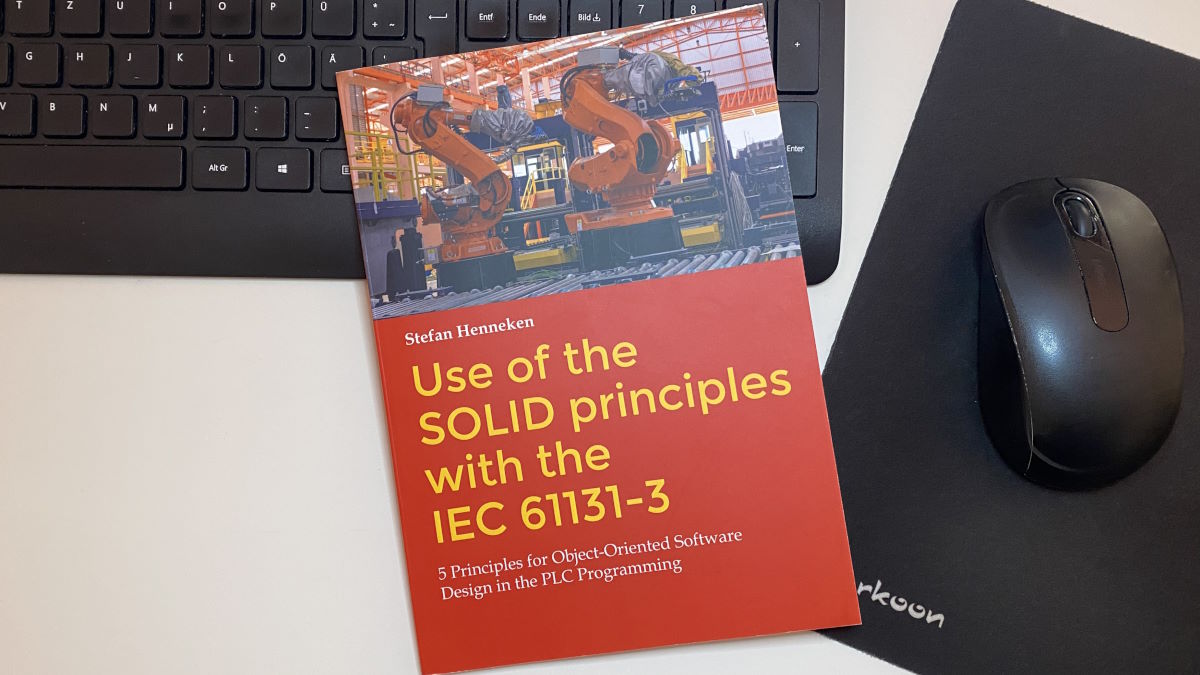
Due to the regular calls for articles about the SOLID principles, I decided some time ago to offer this series in the form of a small book. This book can now be ordered (as a paperback and as an e-book) from all well-known bookshops and digital platforms. In addition to the SOLID principles, the book also addresses the KISS, DRY, LoD and YAGNI principles.
Continue reading “Book release „Use of the SOLID principles with IEC 61131-3“”IEC 61131-3: The Principles KISS, DRY, LoD and YAGNI

The 5 SOLID principles were presented in the previous posts. In addition to the SOLID principles, however, there are other principles that are also briefly presented here. What all these principles have in common is the goal of making software more maintainable and more reusable.
Continue reading “IEC 61131-3: The Principles KISS, DRY, LoD and YAGNI”IEC 61131-3: Die Prinzipien KISS, DRY, LoD und YAGNI

In den vorherigen Posts wurden die 5 SOLID-Prinzipien vorgestellt. Neben den SOLID-Prinzipien gibt es noch weitere Prinzipien, von denen ich einige ebenfalls kurz vorgestellen möchte. All diese Prinzipen haben das gemeinsame Ziel, die Wartbarkeit und die Wiederverwendbarkeit von Software zu verbessern.
Continue reading “IEC 61131-3: Die Prinzipien KISS, DRY, LoD und YAGNI”Buchveröffentlichung „Anwendung der SOLID-Prinzipien mit der IEC 61131-3“

Auf Grund der regelmäßigen Artikelaufrufe über die SOLID-Prinzipien hatte ich mich vor einiger Zeit dazu entschlossen, diese Serie auch in Form eines kleinen Buches anzubieten. Ab sofort kann dieses Buch (gedruckt, als auch als E-Book) in allen bekannten Buchhandlungen und digitalen Plattformen bestellt werden. Neben den SOLID-Prinzipien werden in dem Buch auch die Prinzipien KISS, DRY, LoD und YAGNI angesprochen.
Continue reading “Buchveröffentlichung „Anwendung der SOLID-Prinzipien mit der IEC 61131-3“”IEC 61131-3: SOLID – The Open/Closed Principle

Inheritance is a popular method for reusing existing function blocks. It enables new methods and properties to be added or existing methods overwritten without requiring access to the source code for the base function block. Designing software so that it can be extended without modifying the existing code is the key concept behind the Open/Closed Principle (OCP). But using inheritance also has disadvantages. These disadvantages can be minimised by employing interfaces – and this is not the only advantage of this method.
Continue reading “IEC 61131-3: SOLID – The Open/Closed Principle”IEC 61131-3: SOLID – Das Open/Closed Principle
Vererbung ist eine beliebte Methode, um bestehende Funktionsblöcke wiederzuverwenden. Dadurch lassen sich Methoden und Eigenschaften hinzufügen oder bestehende Methoden überschreiben. Hierbei ist es nicht notwendig, den Quellcode des Basis-FB zur Verfügung zu haben. Software so zu designen, dass Erweiterungen möglich sind, ohne die vorhandene Software zu verändern, ist die Grundidee des Open/Closed Principle (OCP). Doch die Anwendung von Vererbung hat hierbei auch Nachteile. Der Einsatz von Schnittstellen minimiert diese Nachteile und bietet zusätzliche Vorteile.
Continue reading “IEC 61131-3: SOLID – Das Open/Closed Principle”IEC 61131-3: SOLID – The Interface Segregation Principle

The basic idea of the Interface Segregation Principle (ISP) has strong similarities with the Single Responsibility Principle (SRP): Modules with too many responsibilities can negatively influence the maintenance and maintainability of a software system. The Interface Segregation Principle (ISP) focuses on the module’s interface. A module should implement only those interfaces that are needed for its task. The following shows how this design principle can be implemented.
Continue reading “IEC 61131-3: SOLID – The Interface Segregation Principle”IEC 61131-3: SOLID – Das Interface Segregation Principle
Der Grundgedanke des Interface Segregation Principle (ISP) hat starke Ähnlichkeit mit dem Single Responsibility Principle (SRP): Module mit zu vielen Zuständigkeiten können die Pflege und Wartbarkeit eines Softwaresystem negativ beeinflussen. Das Interface Segregation Principle (ISP) legt den Schwerpunkt hierbei auf die Schnittstelle des Moduls. Ein Modul sollte nur die Schnittstellen implementieren, die für seine Aufgabe benötigt werden. Im Folgenden wird gezeigt, wie dieses Designprinzip umgesetzt werden kann.
Continue reading “IEC 61131-3: SOLID – Das Interface Segregation Principle” Stefan Henneken