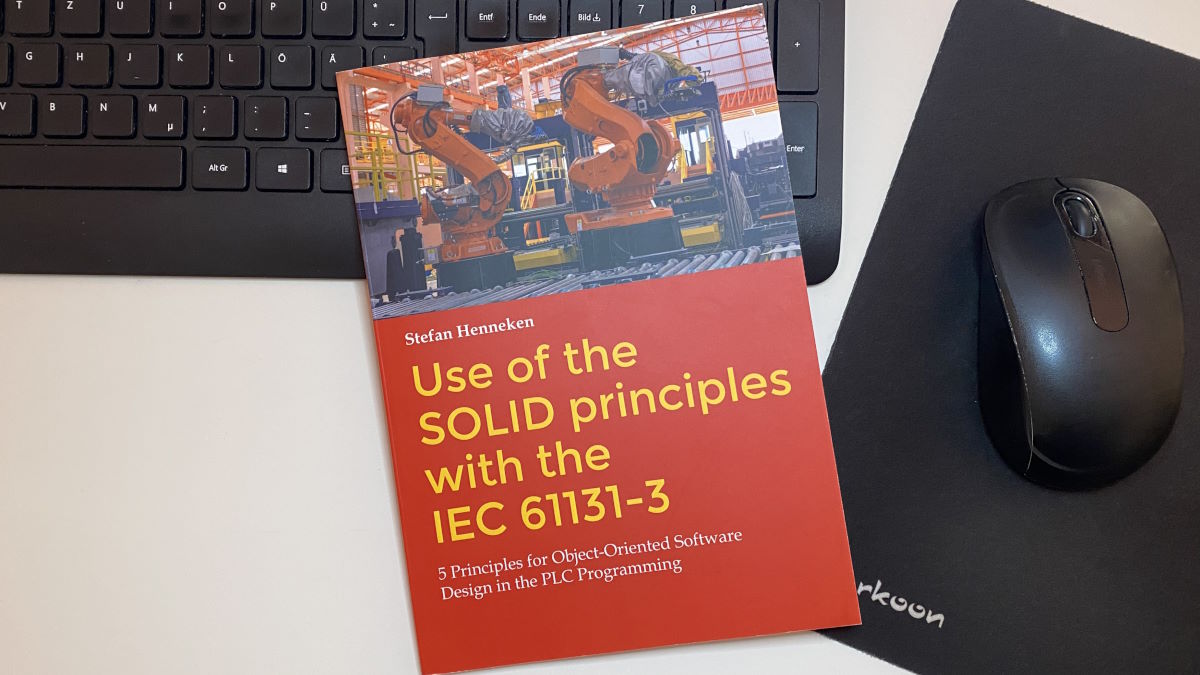
Due to the regular calls for articles about the SOLID principles, I decided some time ago to offer this series in the form of a small book. This book can now be ordered (as a paperback and as an e-book) from all well-known bookshops and digital platforms. In addition to the SOLID principles, the book also addresses the KISS, DRY, LoD and YAGNI principles.
Of course, the previous articles are still available free of charge here on the blog. This means that everyone is free to decide whether they would prefer to read the articles online, on an e-book reader or as a printed book.
The price for the almost 100-page book is €6.99 for the printed version (ISBN-13: 9783757892227) and €4.99 for the e-book (ISBN-13: 9783758356148).

 Stefan Henneken
Thank you for the release! It’s already ordered. Do you plan to publish a book with design patterns also?
Hello Damian, There is currently no concrete plan. I am currently planning to publish some general articles about IEC 61131-3 here on the blog. But let’s see what happens in one year.
Hi Stefan!
I’ve just finished (and much appreciated) he book. Just wanted to report a mistake page 74 “in the 1980iger years…” -> “in the 1980s…”
Hi Riccardo,
thanks for reading my book and for the hint.
In my Blog I fixed the error directly. In the next edition of the book, I will also adapt it there.
Stefan
Hello Stefan,
I know at least 3 people that have bought the book (myself included) already.
A small question. At my company, we were looking at IEC 61131 norms lately. I was wondering, if there was any specific reason for TwinCAT to not support CLASS…END_CLASS keywords? Is it because FUNCTION_BLOCK provides more capabilities?
Hello Piotr,
It is true that CoDeSys does not support everything contained in IEC 61131-3 Ed. 3. One of these topics is CLASS. But basically everything is possible with the function blocks in TwinCAT that was defined in IEC 61131-3 with the CLASS.
Hi Stephan.
Books just arrived, I am very curious to read it.
I am a TwinCAT developer since several years.